
Blendies
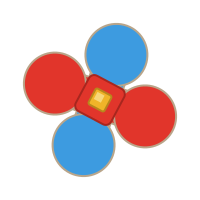
A spinning top. Color the pieces, spin it, and watch the colors blend.
- Ages
- 5 to 12
- Prep
- 5 to 10 min
- You provide
- A smooth floor or large table
 Sparks for Clinicians
Sparks are playful engineering projects from FutureMakers. Each pack has the parts a child needs to build something that moves, like a spinning top or a puppet with a mouth that opens. Clinicians have used Sparks informally for several years, and we're hearing more interest. Now we want to learn how Sparks can help BCBAs and their teams support client goals, one on one and in small groups. Sign up by October 5.
A spinning top. Color the pieces, spin it, and watch the colors blend.

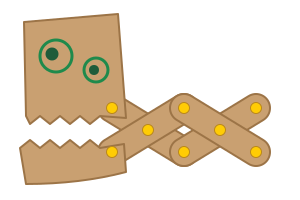
A lever puppet. Draw a character, attach it, and pull to make it move.
Each Spark comes with a clinician Playbook written with Allison Stotmeister, MA, BCBA, LBA, of A&W Consulting: example goals by domain, a picture task analysis, a data sheet, and a communication board.
Both contain small parts. Check fit for clients with pica or mouthing.
Tell us about your practice and your clients. It takes about 4 minutes.
Free, one build per client, with the Playbooks.
However fits your sessions.
A 20-minute call about what worked. We send a $25 gift card as thanks.
We're looking for BCBAs, BCaBAs, speech-language pathologists, occupational therapists, and clinical directors who work with children ages 5 to 12, in clinics, homes, or schools.
Nothing. Packs and shipping are free.
Sparks started in classrooms and libraries. The clinician Playbooks leave out the school content. You choose goals from the client's plan.
Yes, with your training and supervision. The picture task analysis and video make that easier.
Then it isn't the right activity that day.
Allison Stotmeister, MA, BCBA, LBA, of A&W Consulting, with our design team. It's a first draft, and the pilot is how we find out what to change.
No. It's a first draft. Use what helps and tell us what didn't.
You keep everything we send, and you hear first about what we make next for clinicians.
FutureMakers, a small team in Baltimore that has made Sparks since 2011. More about us.
We're a small team of designers and educators in Baltimore. Since 2011, we've made Sparks, playful engineering projects that kids build, play with, and keep.
We design and test every Spark with kids from many settings, including children with identified disabilities. A good Spark is quick to start, gives the child real choices, and ends with something they made themselves.
Most Sparks are used in classrooms, libraries, and after-school programs across the US. Clinicians have been using them informally for years. This pilot is the first time we're designing with clinicians on purpose.
The clinician Playbooks are written with Allison Stotmeister, MA, BCBA, LBA, of A&W Consulting, LLC, a Maryland consulting practice that works with ABA clinics.
FutureMakers, 1700 W. 41st Street, Unit 475, Baltimore, MD 21211
(202) 683-8609 · [email protected]
Materials for embedding treatment-plan goals in a Blendies session.
Pilot draft. Written with Allison Stotmeister, MA, BCBA, LBA, A&W Consulting.
BCBAs, RBTs, and other clinicians using Blendies in NET, 1:1 sessions, small groups, or social skills groups.
Choosing materials, following a sequence, experimenting, and sharing the result create repeated opportunities to capture and contrive, without turning the session into a string of discrete demands. Select targets from each client's assessment results and current goals.
Full walkthrough for staff, using point-of-view video modeling. Staff watch it before the first session and can also watch it with clients.
In production. Link sent with your pack.
Follows the Blendie Build Guide, one step at a time.
Find the client's current targets by domain, then choose the example that matches their level.
| Domain | Target skill | Building foundational skills | Expanding foundational skills |
|---|
Shared markers, paired builds, and turns spinning create peer opportunities with no extra materials.
| Area | Target skill | What it looks like with Blendies |
|---|
For individual or group targets. Circle the prompt level for each opportunity.
| Client: ____________ | Date: ________ | Prompt level |
|---|---|---|
| Target skill | Opportunity | |
| Example. Client will independently mand for actions using single-word verbs or approximations (for example: push, open, spin, go) in 4 of 5 opportunities per session, across 3 consecutive sessions. | Help | I V G PP FP NR |
| Push | I V G PP FP NR | |
| Spin | I V G PP FP NR | |
| Color | I V G PP FP NR | |
| Open | I V G PP FP NR | |
| I V G PP FP NR | ||
| I V G PP FP NR | ||
| I V G PP FP NR |
Core and activity-specific vocabulary, for use alongside a client's existing communication system.
Symbols in design. Core words outlined.
Ask during or after the activity. Visual response options in design.
| Question | Skill area |
|---|---|
| What colors did you use? | Tact, intraverbal (WH) |
| What colors did you make when it spun? | Tact, intraverbal (WH) |
| How did the Blendie move? | Tact actions, intraverbal (WH) |
| Did you like it faster or slower? | Choice making, preference |
| What was one thing we needed to make the Blendie? | Intraverbal (WH), recall |
| How do you feel after making the Blendie? | Emotion labeling |
New arrangements, color combinations, and patterns for repeat sessions.
Coming.
One-page handout for caregiver training.
Coming.
Thank you. We've sent a confirmation to your email. We'll follow up once we've reviewed requests, and ask for a shipping address if you're selected.